SHALL, a new work created by Mary Ellen Carroll / MEC, studios for the exhibition How To Talk Dirty and Influence People a the Contemporary Arts Museum Houston, curated by Rebecca Matalon.
SHALL is built upon the notion that a museum exhibition can come as close as possible to producing zero waste. The work is realized through three commitments: 1) designing a circular system for the exhibition to eliminate building waste such as drywall by using Layher’s state of the art modular scaffolding as its structure and by employing reusable materials in the exhibition design (by architect Juliana Zeibell with CAMH’s head preparator Jeff Shore); 2) transporting the exhibition from New York City to Houston by electric cargo truck with Buoy Fine Art Services—understood to be the first long-haul EV transport for an art exhibition in the world—and 3) Charting the museum’s energy usage and the renewable energy sources.
______________________________________________________
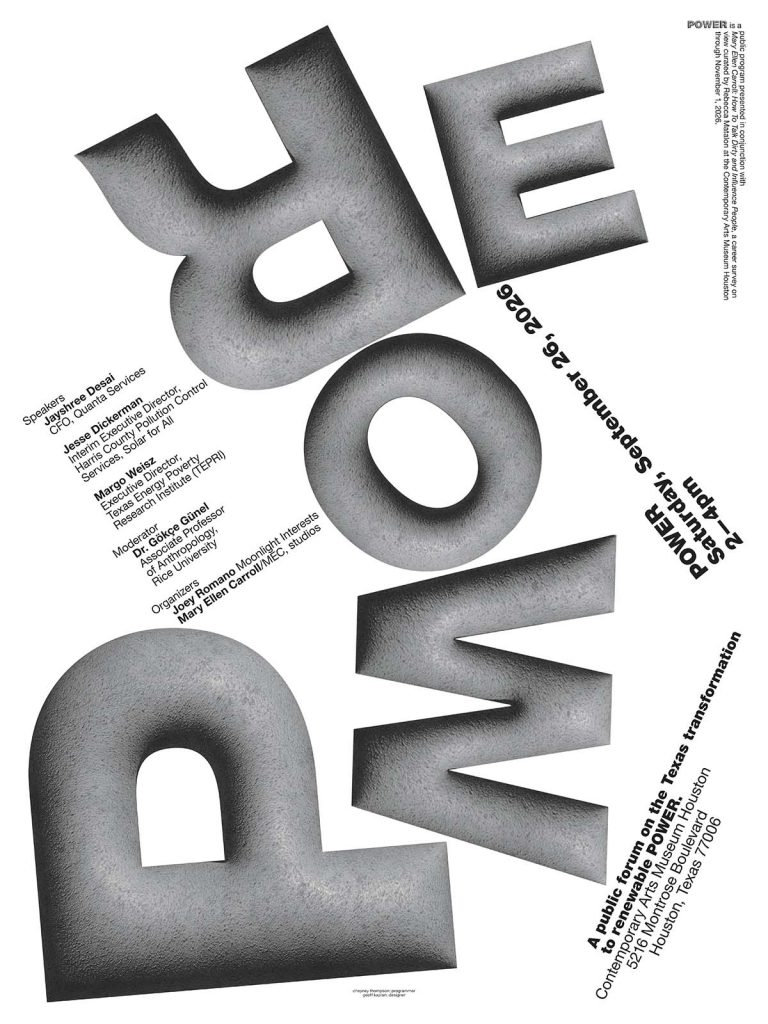
POWER
The most significant shift in power in the world is underway.While fossil fuels still dominate the American narrative about energy, Texas and its electrical grid are increasingly powered by renewables. How is this signifcant shift in power receiving so little attention and sustained public discussion? What does its relative invisibility reveal about the cultural, political, and economic infrastructures through which power is produced, distributed, and understood?
POWER, a public forum organized in response to these questions, brings together key individuals across the public sector, government, and industry who are actively transforming the field to make visible the materiality and infrastructure shaping this transformation.
Across Texas, particularly in rural areas and where the majority of data centers are sited is also where solar and wind farms, battery storage facilities, and transmission infrastructure are being realized. The public focus on these sustainable sources often takes the form of debate over individual projects. But, it is important to recognize these all constitute an overarching infrastructural transformation through which renewable energy has become a dominant source of electricity generation within the Electric Reliability Council of Texas (ERCOT) grid.
POWER, co-convened by renewable energy developer Joey Romano and conceptual artist Mary Ellen Carroll, considers the present and offers a forward-looking perspective on power from the unique vantage point of Houston—the “energy capital” of the world.
The forum is presented in conjunction with Carroll’s career survey, How To Talk Dirty and Influence People, at the Contemporary Arts Museum Houston, curated by Rebecca Matalon. It emerges specifically from SHALL, a new work created by Carroll for the exhibition.
SHALL is built upon the notion that a museum exhibition can come as close as possible to producing zero waste. The work is realized through three commitments: 1) designing a circular system for the exhibition to eliminate building waste such as drywall by using Layher’s state of the art modular scaffolding as its structure and by employing reusable materials in the exhibition design (by architect Juliana Zeibell with CAMH’s head preparator Jeff Shore); 2) transporting the exhibition from New York City to Houston by electric cargo truck with Buoy Fine Art Services—understood to be the first long-haul EV transport for an art exhibition in the world—and 3) Charting the museum’s energy usage and the renewable energy sources.
It is an unusual proposition: a work of art that takes the making of a museum exhibition as its material becomes the catalyst for a public forum on the present and future of power, making a systemic transformation visible to the public.
POWER
Saturday, September 26, 2026, 2 pm to 4 pm
Organized by Mary Ellen Carroll and Joey Romano
Contemporary Arts Museum Houston
5216 Montrose Boulevard, Houston, Texas 77006
The Materiality and Infrastructure of Power
Moderator
Dr. Gökçe Günel, Associate Professor of Anthropology, Rice University (Infrastructure, Energy, Climate)
Speakers
Jayshree Desai, CFO, Quanta Energy, Photovoltaic, Wind Energy, and Storage
Interim Executive Director, Harris County Pollution Control Services | Solar For All |
Margo Weisz, Executive Director, Texas Energy Poverty Research Institute (TEPRI)
POWER: MATERIALITY and INFRASTRUCTURE
MODERATOR
Dr. Gökçe Günel
Dr. Gökçe Günel is Associate Professor of Anthropology at Rice University, where her research examines infrastructure, energy, and climate change. She is the author of Spaceship in the Desert and Floating Power: Energy, Infrastructure, and South-South Relations.
SPEAKERS
Jayshree Desai, CFO, Quanta Services
Quanta Services is one of North America’s largest builders of energy infrastructure, including electric transmission and distribution systems, substations, and utility-scale wind, solar, and battery-storage facilities. Jayshree Desai’s career in renewable energy includes leadership roles at EDP Renewables North America, Clean Line Energy Partners, and ConnectGen.
Jesse Dickerman
Jesse Dickerman is Interim Executive Director of Harris County Pollution Control Services and has held senior leadership roles in Harris County focused on administration, energy transition, and sustainability. Jesse Dickerman’s work has included establishing the County’s Office of Sustainability and helping implement its $250 million Solar for All initiative.
Margo Weisz, ED, TEPRI
Margo Weisz is Executive Director of the Texas Energy Poverty Research Institute (TEPRI), an independent nonprofit advancing energy solutions for low-income communities across Texas. Margo Weisz has helped conceptualize and launch TEPRI and has more than two decades of experience developing initiatives for underserved communities.
ORGANIZERS
Joey Romano
Joey Romano is a Houston-based renewable-energy developer. He developed Houston’s first merchant solar-power project and Texas’s first community-solar program in a competitive retail electricity market.
Mary Ellen Carroll
Mary Ellen Carroll is a conceptual artist whose work over more than four decades has engaged architecture, public policy, film and media, technology, and language as materials. Their career survey, How To Talk Dirty and Influence People, is on view at the Contemporary Arts Museum Houston until November 1, where the public forum — POWER emerges from Carroll’s new work SHALL.
________________________________________________

COUNTING and COLLECTING (Votes and Trash)
A public forum to examine the post-election process and the issue of illegal dumping in Houston, Texas.
Thursday, October 22, 2026, 6:00–9:00 p.m
Contemporary Arts Museum Houston
Organizers Mary Ellen Carroll and Evan Choate
COUNTING (Votes) 6:00 – 7:30pm
Moderator Senator Molly Cook — Texas State Senator
Speakers
Teneshia Hudspeth, Harris County Clerk and Chief Election Official
Annette Ramirez, Harris County Voter Registrar Organizers Mary Ellen Carroll and Evan Choate
COLLECTING (Trash) 7:30 – 9:00 pm
Moderator Martin Melosi, University of Houston, Cullen Professor Emeritus of History
Speakers
Andrew Beaver, Clean the Block, Houston
Bryce Randall, Policy Director, Office of Council Member Alejandra Salinas, City of Houston
Joetta Stevenson, President, Greater Fifth Ward Super Neighborhood
COUNTING and COLLECTING (Votes and Trash)
What becomes visible when policy is counted—and when it is not collected?
COUNTING and COLLECTING (Votes and Trash) is an evening organized as a public forum before the November 2026 election to examine the post-election process and the counting of votes and the persistent and highly visible civic issue of illegal dumping. Bringing together elected officials, policymakers, community organizers, and activists, the program considers Houston and Texas in relation to the national political landscape and asks how policy is enacted, experienced, and made visible. The forum is a public program organized by conceptual artist Mary Ellen Carroll and political strategist Evan Choate as a part of Carroll’s career survey at the Contemporary Arts Museum Houston, curated by Rebecca Matalon — How To Talk Dirty and Influence People.
VOTES — in anticipation of the November election — looks beyond campaigns and candidates to what happens after a ballot is cast. The counting, certification, administration, and interpretation of election results constitute an essential but largely non- visible infrastructure of democracy. The discussion is to provide information to the public considers how votes will be counted and translated into political power in Houston and Texas; how local and state electoral systems operate in relation to the national election; and what happens when political authority and policy diverge across municipal, county, state, and federal governments.
Rather than a forum to predict the outcome of the election, VOTES asks what structures will determine how that outcome is counted, understood, and ultimately acted upon and the answers as information for the public will be provided.
TRASH — if the infrastructure surrounding the counting of votes is largely non-visible, illegal dumping is its opposite: an immediately visible manifestation of how public systems and policies fail to operate in equal measure for all.
Across Houston, illegally dumped construction debris, household waste, tires and other materials accumulate in public spaces, with neighborhoods of color disproportionately confronting the consequences. TRASH brings together local activists and organizations and policy makers working directly on the issue to examine why illegal dumping persists, what policies and enforcement mechanisms currently exist, whether they are effective, and what needs to be done in addition to what needs to be done in addition to enforcement to prevent dumping, support affected communities, and hold those responsible accountable.
The discussion asks not simply how trash can be removed, but what its continued accumulation reveals about infrastructure, municipal services, environmental justice, enforcement, public investment, and political responsibility.